
Message from the Dean
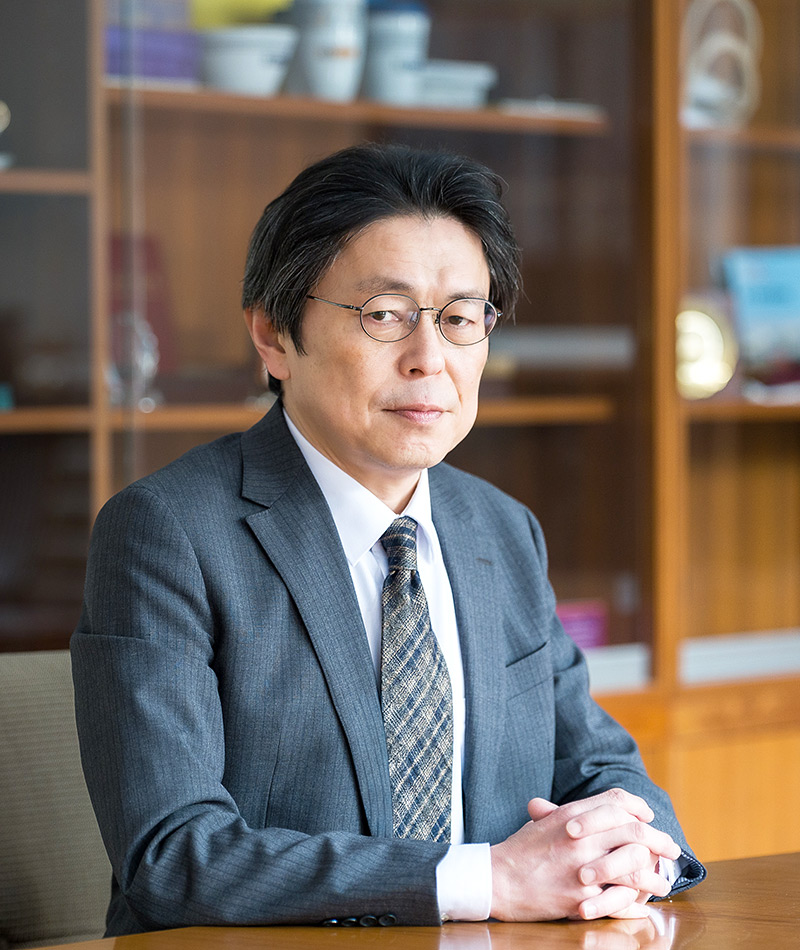
The Graduate School of Integrated Arts and Sciences, established in April 2026, is founded on the principle of “cultivating people who will take the initiative and work collaboratively to solve human and social issues that cannot be resolved through specialized knowledge in a single field alone, namely by creating a space for the generation of ‘convergence knowledge.’” The reason “convergence knowledge” is enclosed in quotation marks here is that this term is a quotation. Our graduate school has adopted someone else’s words as its own guiding principle. We chose to speak through quotation and make no attempt to hide that fact. Of course, since we all have no choice but to speak through the words of others, this in itself is neither good nor bad. The issue lies beyond that. How should we engage with this term, “convergence knowledge,” as words borrowed from another?
Generally speaking, there are two things one should do with a quotation. One is to trace its source; the other is to engage with the quoted words of another in one’s own words. The source can be investigated easily. The 2020 amendment to the Basic Act on Science and Technology incorporated the humanities and social sciences, which had previously been excluded from the scope of “science and technology,” and made “the creation of innovation” one of its pillars. The following year, in 2021, the Sixth Science, Technology, and Innovation Basic Plan, approved by the Cabinet, called for the creation and use of “convergence knowledge” through the fusion of knowledge from the humanities and social sciences with knowledge from the natural sciences. Then, in 2022, the following year, the “Basic Approach to ‘Convergence Knowledge’ and Measures for Its Strategic Promotion (Interim Summary),” defined “convergence knowledge” as “generating the ‘vitality of knowledge’ that creates new value by bringing together diverse forms of ‘knowledge,’” and that Japan’s “path to success” could be found within the scientific and technological progress and creation of innovation enabled by “convergence knowledge.”
Thus, “convergence knowledge” was in effect, a command. It was Tatsuo Hayashi who, during the war, incisively observed that our language consists of “descriptive words” and “imperative words.” Following him, we might say that “convergence knowledge” is an imperative word. Even so, I will not address here whether that is good or bad. Every descriptive word is also, at the same time, an imperative word, and the language of action always seek to imitate the language of reason. The question is still entrusted to each and every one of us. How should we face the demand, or command, of our age that we be integrative in our knowledge?
The answer will likely differ from person to person, but what about this, for example? We might think of “convergence knowledge” as something like a “novel” in which various characters speak in various voices. Precisely because it is merely a novel, there is no need to use one character’s words as a shield to “refute” another character, nor is there any need to go out of one’s way to expel a character simply because they are a supporting character. There are strong characters and weak characters. They form factions or oppose one another, while together creating a single whole. All that is required of a good reader is to try to listen to the various voices within the novel. Or perhaps, while being captivated by the voices of these fascinating others, to try to gently slip in one’s own voice, or even another voice, among them.
This is an attitude diametrically opposed to authoritarianism, which pledges allegiance to a single voice and seeks to crush all other voices. As said by the Palestinian-American critic Edward Said, in a novel, “there must be some strong sense of doubt that the authority of any single voice, or group of voices, is sufficient unto itself.” I believe this is the kind of skepticism required of those of us who gather in a graduate school that proclaims “convergence knowledge.”